

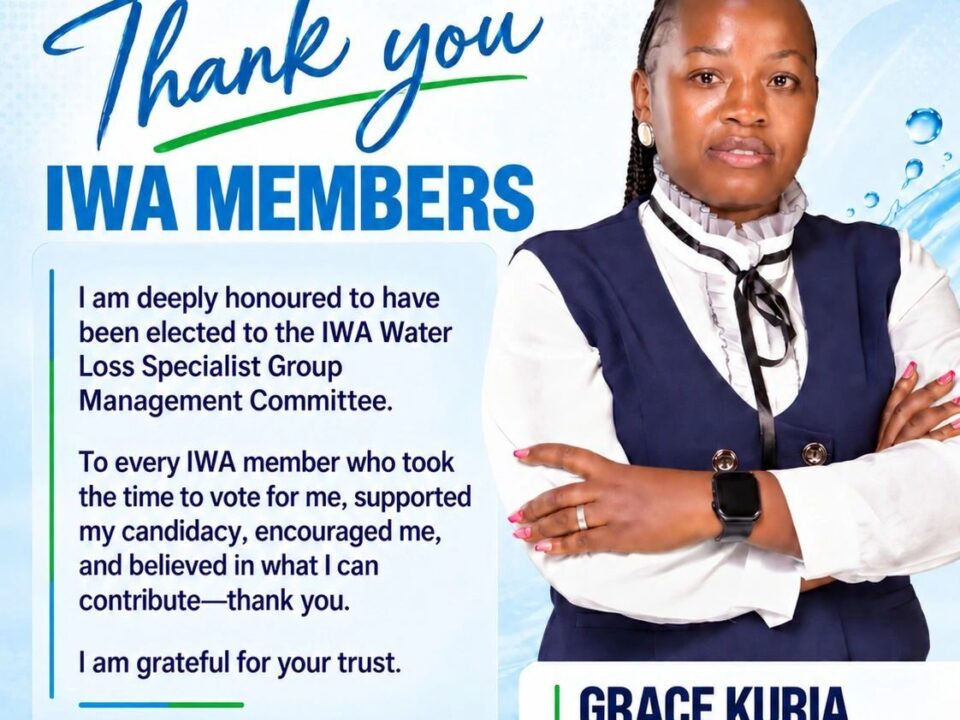
Grace Kuria joins IWA Water Loss Specialist Group Management Committee
Kenyan water-sector professional Grace Kuria has secured an international leadership position after being elected to the Management Committee of the International Water Association (IWA) Water Loss Specialist Group.
Kuria, who serves as a Non-Revenue Water (NRW) Officer at Nyeri Water and Sanitation Company (NYEWASCO), joins an international network of professionals working to advance approaches for reducing water losses and improving the efficiency and sustainability of water utilities.
Her appointment places Kenyan utility experience within a global professional platform at a time when non-revenue water remains one of the most persistent challenges facing water service providers.
Tackling the water that never reaches consumers
Non-revenue water refers to water that has been produced and enters a distribution system but does not generate revenue for the utility. Losses can result from physical leakages, inaccurate or malfunctioning meters, illegal connections and weaknesses in billing and customer-data systems.
The challenge has significant implications for utilities. Water that is lost still carries production, treatment and distribution costs, meaning high NRW can put additional pressure on utility finances while reducing the amount of water available for customers.
Across Africa, water losses can exceed 40 per cent of water produced in some systems, highlighting the scale of the challenge facing utilities.
Bringing Kenyan experience to the global conversation
Kuria’s role with the IWA specialist group provides an opportunity for experience from Kenya’s water utilities to contribute to international discussions on water-loss management.
For utilities operating in water-stressed environments, NRW reduction can be an important component of improving service efficiency without relying exclusively on developing new water sources.
Measures can include active leakage control, pressure management, district metered areas, improved metering, regular network maintenance, accurate customer databases and the use of digital technologies to identify abnormal consumption and potential leaks.
Efficiency as part of water security
Reducing water losses is increasingly being viewed as an important part of water-resource management.
For a utility, recovering water currently lost through the distribution network can increase the volume available for customers without necessarily requiring the same level of investment associated with developing an entirely new water source.
This makes NRW management particularly relevant as cities grow, demand increases and climate variability places additional pressure on available water resources.
Efficient distribution networks can also reduce unnecessary energy consumption associated with treating and pumping water that ultimately does not reach paying customers.
Strengthening professional capacity
Kuria’s international appointment also highlights the importance of specialised technical expertise within water utilities.
NRW management requires professionals who understand the interaction between hydraulic systems, customer data, metering, finance, operations and asset management.
As utilities increasingly adopt smart meters, digital mapping, remote monitoring and data-driven network management, the role of specialised NRW teams is likely to become even more important.
A wider role for East Africa
The challenges faced by Kenyan utilities are shared across much of East Africa, where rapidly growing urban populations are increasing demand for reliable water services while infrastructure in many systems requires continued investment and rehabilitation.
Regional knowledge exchange can therefore play an important role in accelerating practical solutions.
Kuria’s election to the IWA Water Loss Specialist Group provides a platform for Kenyan experience to contribute to that wider conversation, while also creating opportunities to learn from approaches being implemented by utilities and water professionals in other parts of the world.
For East Africa’s water sector, reducing water losses is ultimately about more than improving utility revenues. It is about making every cubic metre of treated water count—and ensuring that scarce water resources reach the communities they are intended to serve.
